Showing posts with label lies. Show all posts

Sunday, January 7, 2018

Cancer Cure?

No there is not a cancer cure. We need to keep remembering that. We are told by our doctors that there is no evidence of disease or some thing along those lines - which just boils down to "we are not capable of finding it yet". If your doctor tells you that you are cured, please find a new one asap.

In this day and age should there be a new definition of cured of cancer? I'm not sure. I have friends who tell me they are cured. I try to figure out what they are talking about. Seriously, where did this cured business come from? I want to question their position on this but in some ways do not want to know.

"Upon completion of treatment, one of only two scenarios exist. Either all cancer cells are annihilated by surgery, chemo or radiation never to return or some of the little cells escaped and plan to mount a future counteroffensive. The trouble is that technical limitations thwart our ability to measure small volumes of cancer cells. Blood work, imaging like PET scans and CT scans or physical exams are simply too crude at present to predict, always and accurately, whether cancer will recur. And so, like Schrodinger’s cat experiment, a quiet cat placed in an opaque box is assumed to be both alive and dead at the same time. You just don’t know. Likewise, cancer cells after treatment are assumed dead, but we go on testing to discover any signs that the disease may have returned. CT scans. Blood work. Physical exams. Ad nauseum. Only time will tell."

So as good patients we go to our doctors for years and do what they say. But we know we are not cured.

"A couple caveats here. First, we generally observe patients for five years. After that point, for most diseases, the curves are flat, meaning that we anticipate few further cancer deaths. Thus, the doctor’s five-year survival is equivalent to a layperson’s “cure.” So when docs uncomfortably utter the word “cure," it’s usually after five years from diagnosis. At that time, we generally feel confident that the disease is gone. Secondly, these are dry boring statistical models. So we know where the group will plot out. Each individual patient, however, that’s another story.

Early on, we don’t know, with any certainty, who will be cured. That’s where the term “remission” comes in: when there’s no sign of any cancer, but it is still too early to tell. When the clock strikes 12 on the fifth anniversary of your diagnosis, voila, “remission” magically transforms to “cure.” Sort of like a reverse Cinderella moment.

And thirdly, and perhaps most importantly in a time of rapidly evolving treatments, all published data is at least five years out of date because you have to wait that that long to collect the data following the treatment performed. Treatment options change a lot during five years."

Five years out are we cured? No we are not. So we stop going to our doctors and promise to come back if anything changes.

And even though we know all of the above, there are still a few more caveats.

"Finally, outliers exist. Unfortunately, patients with early-stage disease can recur and die and those with late-stage disease can outlive their predicted expiration date."

So what do we do? We are supposed to live life as if we are cured. We are supposed to like our new normal. But we are not cured and at this point have no chance of being cured. We can just  be happy with remission free survival and no evidence of disease. But not a cure.

Thursday, April 27, 2017

You Can't Put A Big Bow On A Cancer Diagnosis

When a cancer treatment commercial airs, the people are happy and smiling. The drug or medical center promises they will cure you and you will be back to yourself soon. They want you to believe that they will make it all better.

They are full of bullshit.

"Patients and families are bombarded with the news that the country is winning the war against cancer. The news media hypes research results to attract readers. Drug companies promise "a chance to live longer" to boost sales. Hospitals woo paying customers with ads that appeal to patients' fears and hopes.
"I'm starting to hear more and more that we are better than I think we really are," said Dr. Otis Brawley, chief medical officer at the American Cancer Society. "We're starting to believe our own bullshit."

The consequences are real -- and they can be deadly. Patients and their families have bought into treatments that either don't work, cost a fortune or cause life-threatening side effects.

"We have a lot of patients who spend their families into bankruptcy getting a hyped therapy that [many] know is worthless," Brawley said. Some choose a medicine that "has a lot of hype around it and unfortunately lose their chance for a cure."

Cancer doesn't come with a pretty bow on it (or a stupid ribbon). Basically cancer is nasty. Its a date with death unless you get lucky.

Current advertising wants you to believe they can cure your cancer and keep you smiling. They make all sorts of promises. But those promises are vague. they can extend your life.

But they do not tell you how long - either the medical centers or the pharmaceutical manufacturers - and it could very well only be a couple of months. And those side effects that are printed in tiny type at the bottom of the ad? Well how about a lot of quality time in the bathroom with diarrhea, extreme pain, fever, chills, and shakes? They never tell you that part.

So perhaps there is a little 'fake news' in the commercials for these cancer treatment centers and the treatments themselves. And they do not even provide enough information for patients anyway.

With a cancer diagnosis, we need to not believe the hype and accept the facts while we find the best treatment options for us.

Tuesday, August 30, 2016

Annual Physical

I am just fine. I am damn happy. And perky! And feeling no pain. No that's a big fat lie. I have a lot of pain. I ran out of steam yesterday. I was very tired by the end of the day. Apparently I did too much. All I did was go to the gym. And then the library and one store. That was it. I was wiped out. I even took a break after the gym.

Next week I have my annual physical. I have two options: go in and lie and say everything is fine, or go in and tell the truth about how I feel. This could put me back on a medical roller coaster of a sort. At this point I am not concerned with out going back on the medical roller coaster as I am with being as healthy as I can.

I do not think I have something bad going on. Its just my annual chance to sit down with my primary care physician and go through how I am feeling, what are my concerns, and what we can do to make me do better, or even improve my health - now that's an interesting concept.

Now I just have to make a list of what I want to talk about. Damn.

Thursday, June 19, 2014

Supplements and Dr Oz and other medical inspirationalists

The decline of the TV doctor....Or more specifically false advertising of miracle treatments...


Dr Oz and others have gotten rich by using 'flowery language' to promote supplements for weight loss. Green coffee extract? Didn't Oprah make him famous in the first place? That's another show for medical information... Dr Oz is currently spending his days at the US Senate defending his language and promotion of supplements that do exactly nothing and making scam arts rich.

The problem with these fad supplements are several:
  • Supplements are not tested and approved by the FDA and can contain toxic ingredients and can interact with prescription medication. The message here is do not use them without talking to your doctor.
  • Scammers and others quickly hop on the bandwagon and get rich off the people who believe in what they see on TV.
"Just because you see a supplement product on a store shelf does NOT mean it is safe or effective," the FDA website says. "When safety issues are suspected, FDA must investigate and, when warranted, take steps to have the product removed from the market. However, it is much easier for a firm to get a product on the market than it is for FDA to take a product off the market."

While Dr Oz is grilled in Washington, we just need to remember what we have been told previously. Don't believe what  you see on TV or read online.

Tuesday, January 7, 2014

John Hopkins did not discover a dietary cure for cancer

There are a couple of hoax emails going around that have gotten the folks over at Johns Hopkins riled up enough to write a rebuttal.

I do find this humorous in some ways. How many emails have you gotten offering you a cure for anything you want and more. Either they are based on some known item that you just need to eat more/less of or not something like not cook in saran wrap. Or they refer you to someone far away with a really long name who promises you an elixir or prayer or something else that will cure you.

There are a few things they all have in common:
  • Typographical errors and misspellings.
  • Bad English
  • Over promising
Back in the 19th century we had quack doctors who went around the country selling their cure alls. Now they don't need the horse and buggy, they just need the internet and your email address. But just remember if its too good to be true, it probably is. Use your delete button.

Monday, August 19, 2013

When Its Not News!

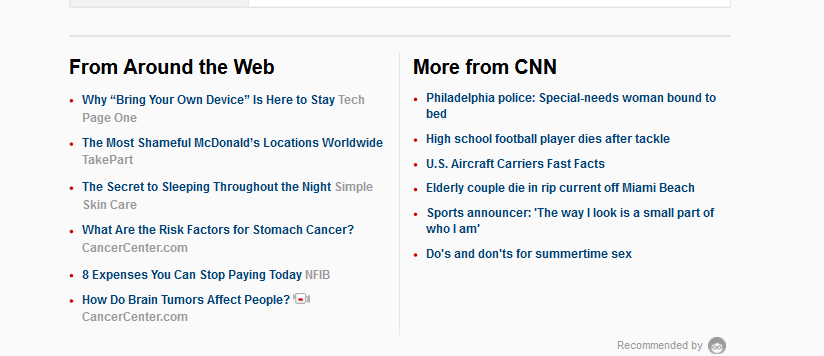
But you think it is. Yesterday I was cruising through the Health section of cnn.com, reading an article here, and another there. At the bottom of each article were links to more articles. I was reading titles, clicking, and reading some more.

I always look at the cancer one, in case they have discovered a cure and I missed it while sleeping or something. The one I saw yesterday was called "Chemotherapy Game-Changer for Stage IV Cancer". Immediately intrigued, I clicked the link and landed here.

Its looks like a lovely article on chemotherapy and stage IV cancer patients. ITS NOT! Its a paid ad or blog post or whatever.

A week or so ago, I was also cruising around the health section of cnn.com and found this article on inflammation which I found barely interesting and biased. It was titled "Chronic Inflammation is the Fuse for Cancer" and it also was an ad. And from the same website, Envita.com, which is the website for a bunch of medical centers.

I felt duped. I found a link on cnn.com and thought I was reading articles, not ads. I did some more poking around and found that it seems there are always more ads linked in among the true articles.


The third article down on the left is titled 'The Secret to Sleeping Throughout the Night". Its basically an ad as well. You will note the source - Simple Skin Care.

I don't think CNN is trying to scam us. I think the stores at the bottom are found by search engines and compiled there - which is why when you go back to the article, chances are the list is different. Its the advertisers who are trying to fool the search engines into thinking they are news and not a load of propaganda.

So the moral of the story is basically 'buyer beware'. Just because you think its news doesn't mean it is.

Friday, January 11, 2013

Here's a surprise!

Researchers lie exaggerate benefits and play down side effects in describing their results. I am SHOCKED I tell you, shocked! And I'm sure its not just for breast cancer drugs.

A recent study in the Annals of Oncology (which you can't read online unless you pay big bucks) found this. I found this describing it:


"Reports on Breast-Cancer Drugs Are Often Biased, Research Finds

Researchers often exaggerate the benefits and play down the potentially toxic side-effects of breast-cancer drugs in clinical trials, according to a new study published in the Annals of Oncology. One way they do this is by emphasizing some secondary benefit of the drug, even if it failed to achieve the primary objective (such as, say, lengthening the life of the patient). High toxicity findings frequently go unmentioned in abstracts and conclusions—perhaps, the authors suggest, “to make the results more attractive.”

The researchers looked at 164 randomized clinical trials from 1995 to 2011 and found evidence of bias in reporting toxicity in 67 percent of those trials. While they note that the pharmaceutical industry is “increasingly influential” in the sponsorship of such trials, they didn’t find any association between industry involvement and bias.

So what do the authors propose be done? Journal editors, regulators, and reviewers should apply “a critical eye to trial reports” to ferret out instances of bias, they say—implying that they have been failing in that responsibility up to now."

Well is anyone else shocked here? First we must insist researchers take lie detector tests. Next markers are not allowed to put their spin on any results. Finally, editors, regulators and reviewers should smarten up.

Doh! Really. This does not surprise me at all. I don't put blame on editors, regulators and reviewers. I am sure they are working with what is presented to them. Is it their job to decipher research? Unless they are scientists I am not sure they are qualified. No the onus goes back to the researchers who run the studies to make sure the data is presented correctly.

Thursday, October 18, 2012

The rise and fall of Lance

Lance Armstrong dealt with a pretty nasty cancer diagnosis and then turned it into something good by creating the Livestrong Foundation. However, it turns out he built his athletic career on steroids and his house of cards has collapsed. I had always admired his athletic feats but now feel like he lied to all of us.

Allow me to clarify. He won 7 Tour De France races. He won an Olympic medal. He was Mr. Clean. He told us for years that he never took performance enhancing drugs. And it turns out he lied to all of us.

This summer when he told the world he was going to stop fighting the charges, I think we started to become aware that there might be some truth to the claim. Now it has all come out that there was a secret system of performance enhancing drugs in the US cycling team. Lance has now stepped down from his world famous charity, he has lost his endorsements, will probably be stripped of his medals, and banned from all future competitions.


Earlier this year we watched another famous charity, the Komen Foundation (for the Cure) suffer a significant setback with the Planned Parenthood debacle. It would be a shame if another big charity, the Livestrong Foundation, also suffered as the result of the lies told by its founder.

It is also a shame that the dishonesty of one man will impact the lives of so many others. We have lost a hero who was a symbol of hope for many that you can return after cancer and exceed your previous expectations.

It might be time for Lance to step back from the limelight and let those who do not lie to shine. Honesty is always the best policy and its time he realized that.

Saturday, April 28, 2012

Cancer myths

There are more myths about breast cancer and all other cancers. You know the ones - you can get breast cancer from wearing deodorant, underwire bras, living near power lines, blah, blah, blah. If anyone tells you they know how you got your cancer, just like if they tell you their 'cure' for cancer, they are full of you know what. And you can tell them (as politely as you want) to go take a hike.

One myth I think is overwhelmingly stupid. 1 in 8 is not your chance of getting breast cancer in your lifetime. 1 in 8 is the chance you will get breast cancer when you are 85. The stupidity that allows this one never ceases to amaze me. If anyone says it, I would reply 'liar, liar, pants on fire'.

But there is one myth that is still a myth unfortunately. That is that breast cancer is preventable.


'Alas, no. Although it is possible to identify risk factors (such as family history and inherited gene mutations) and make lifestyle changes that can lower your risk (reducing or eliminating alcohol consumption, losing weight, getting regular exercise and screenings, and quitting smoking), roughly 70% of women diagnosed with breast cancer have no identifiable risk factors, meaning that the disease occurs largely by chance and according to as-yet-unexplained factors.'

You can try as much as you might but you can not eliminate the risk of breast or any other cancer in your life. This is the one myth I would like to see proven.

Sunday, October 23, 2011

I wasn't evasive

I detest evasiveness. At times I find it rude. If someone asks you a question and you don't want to answer, it is polite to give some sort of answer and then change the subject to something you are more comfortable discussing. That is basic. But its the one's who will never answer any questions  on any subject that really rile me. If you say 'did you have a nice lunch?' and they can't give any kind of answer - from it was okay, I had a tuna, I skipped lunch and went shopping or whatever but the lack of any kind of answer becomes rude. I don't need to know everyone's life story but sometimes a light conversation becomes impossible. Someone who is incapable of answering any kind of question, especially if they seek you out for social events, either has significant 'issues' and/or no social skills.

I know a few people but don't spend time with them because they don't answer questions. They only ask me questions.  If you ask them an innocuous question such as 'what did you do for the holiday?' they evade the question. That is an easy question you could answer it in any number of ways 'I saw some friends, got together with family, went to a restaurant, brought a pie over to join friends for dessert, etc'. One woman said to me 'I didn't do anything'. A few weeks later another friend told me that she came to their house for the holiday. The original answer was basically a lie which is very rude.

I find when I spend time with people like this, I feel very frustrated. It is impossible to have a conversation with them, you can never get a clear answer, and I come away from it resenting them. They seem to want to know everything about me but refuse to tell me anything about them in return. It should be an even trade. You asked me what I did for the holiday and I told you but when I ask you, you lied. You asked me what I did for lunch and I told you but when I asked you in return, you couldn't/wouldn't answer.

I have had this happen with these people even when making choices on a menu at a restaurant - Caroline, what are you going to have?' 'I'm thinking of the chicken. What about you?' 'Why are you choosing the chicken, what do you think of the steak?' 'I'm in the mood for chicken.' 'Are you getting a salad or vegetables?' And on and on and on. Um, is my opinion that important to you or are you just incapable of making your own decision or have no social skills or practicing your skills for the next inquisition?

What happens in the end is I refuse to spend time with them and avoid them. I don't consider them a friend at any level and don't waste my time with them as I think they are rude.

However there are times when a little evasiveness is called for. I am sometimes evasive with my health issues when I am not ready to discuss them. If asked if about something I am not ready to discuss, I simply say 'I'm waiting to go back to my doctor', or 'I'm feeling okay these days', etc. Which is some sort of answer and allows for a conversation. I also sometimes use some evasiveness to edit myself. When I wear my lymphedema sleeve - which is only at the gym or when my arm is bothering me - sometimes people ask what it is. I have taught myself to just say it is a compression sleeve and that's it. Its the truth, its a compression sleeve but there is no reason for me to go on and say 'well I had breast cancer and now lymphedema'. I do not need to spew out my medical history to virtual strangers.

Earlier this week, a woman walked into the locker room a t the gym as I was putting on my sleeve before going to lift weights. She asked what the sleeve was for and I said it was a compression sleeve due to arm issues. That was enough. That was all she needed to know. I was slightly evasive I felt but told as much of the truth as I wanted. She got an answer that she was seeking and was satisfied. We both were happy with the interaction.

I left the locker room and went into the weight room where there was a woman working out. She asked me 'did you have an axiallary node dissection? I'm a physician. But I don't mean to pry." I said yes and we had a discussion about how long after surgery that I developed lymphedema (1.5 years) and what caused it (a fall on my arm on ice). But we didn't discuss my cancer etc. It wasn't part of the discussion. In the second  conversation I told what as much of the truth as I wanted and she got the answer she was seeking and was satisfied as well. We were also both happy with the interaction. I felt I was a little evasive by not telling the whole story but I also didn't feel the need to unload my medical history - she wasn't my doctor.

The balance of evasiveness with telling the polite truth can be a fine one. Not everyone wants to know my medical history anyway. Its also me coping with my issues in learning to talk about things politely without evading and without recounting my entire medical file. I don't want to be rude and think I have figured out basic politeness by now.

I Started a New Blog

I started this blog when I was diagnosed with breast cancer in 2007. Blogging really helped me cope with my cancer and its treatment. Howe...